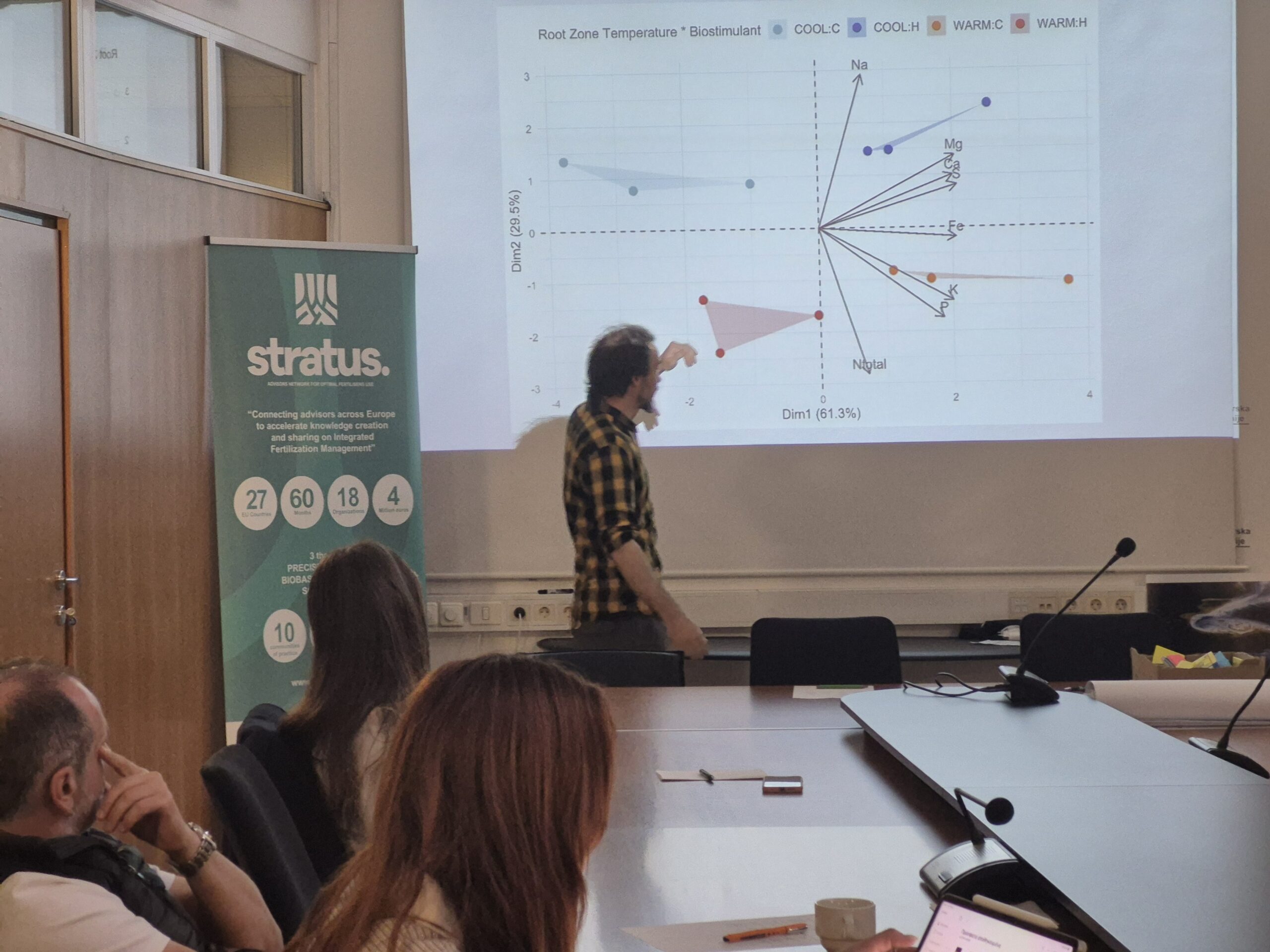
In May 2026, the Chamber of Agriculture and Forestry of Slovenia (CAFS) proudly hosted an international STRATUS Cross Visit, bringing together agricultural advisors and experts from across Europe. The focus of the two-day event was clear: exploring the optimization of fertilization using non-microbial biostimulants and real-time monitoring tools to build crop resilience.
The Host: A Hub of Agricultural Innovation
The centerpiece of the visit was the Turk Farm, located in Brod near Podbočje in SE part of Slovenia. Cultivating approximately 55 hectares of arable land, the farm specializes in vegetables, potatoes, strawberries, and seedling production. Operating in a sub-continental climate characterized by hot summers and a high risk of drought, the Turk family has had to adapt rigorously to unpredictable weather patterns.
Their infrastructure is highly advanced. Drawing water from the nearby Krka River, the farm utilizes a private irrigation system equipped with sand filters, UV disinfection, and computer-controlled fertigation to ensure precise dosing of water and nutrients. Furthermore, their seedling greenhouses are heated with biomass energy and actively ventilated to mitigate abiotic stress.
The Best Practice: Decades of Biostimulant Use
To maintain production stability despite climate extremes, the Turk Farm has been utilizing biostimulants for over 20 years. The European advisors observed how these products, sourced from suppliers like Haifa Group, Amalgerol, and Tradecorp, are applied both preventively (prior to transplanting or forecasted extreme weather) and curatively (when plants exhibit visible stress signs).
Taking innovation a step further, the farm recently implemented state-of-the-art sensors and software to monitor real-time soil nutrient levels, UV radiation, temperature, and soil moisture. This allows them to apply biostimulants and fertilizers exactly when and where the plants need them most.
Insights from the Field: Pearls, Puzzles, and Proposals
Following the field demonstration, the visiting European advisors engaged in a “Pearls, Puzzles, Proposals” (PPP) workshop to evaluate the practice and its transferability across the EU.
- The Pearls (Key Benefits): Participants were highly impressed by the visible increases in crop quantity and quality. Advisors noted that as the availability of approved chemical pesticides in Europe continues to decrease, farmers must put extra effort into finding alternative products that enhance plant resilience. Biostimulants offer a crucial lifeline, helping crops withstand severe abiotic stresses such as frost, extreme heat, drought, and increasingly devastating hail storms.
- The Puzzles (Challenges): The visiting experts also identified significant practical hurdles. One major technical puzzle is plant sensitivity: the farmer highlighted that standard concentrations of certain biostimulants can burn the leaves of young, sensitive seedlings. A broader, systemic challenge was also observed regarding market access. Participants noted that innovative agricultural technology companies tend to focus their visits and promotions almost exclusively on larger farms, leaving smaller operations struggling to access new knowledge and tools.
- The Proposals (Takeaways): To address the technical challenges, the primary advice for farmers adopting this practice is to strictly follow product instructions and proactively use lower concentrations when treating young seedlings to prevent leaf burn. For the European advisory community, the call to action was clear: advisors must step in to bridge the gap between tech companies and smaller farms, ensuring that all European farmers, regardless of size, have access to real-time data monitoring and resilience-building biostimulants.
Ultimately, the Slovenian Cross Visit proved to be a resounding success, demonstrating that the thoughtful integration of biological solutions and precision technology is a highly viable path toward a sustainable and climate-resilient agricultural future in Europe.