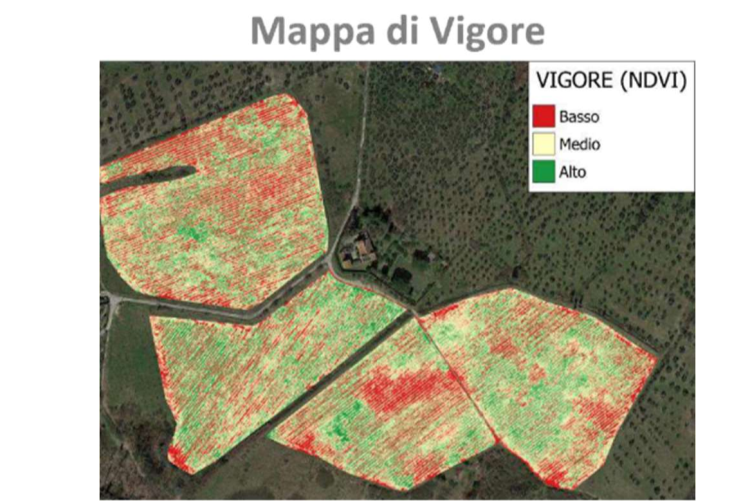
Photo credit: STRATUS
Site-specific fertilization using vigor maps is a precision farming technique designed to optimize fertilizer use, enhance agricultural yields, and minimize nutrient losses and environmental impacts. These vigor maps are generated from data collected through sensors mounted on agricultural machinery, drones, or satellites. The sensors capture detailed information about plant health using indices such as the Normalized Difference Vegetation Index (NDVI). NDVI measures the ability of plants to reflect light in the near-infrared spectrum, which is a strong indicator of vigor and active photosynthesis. For optimal accuracy, multispectral cameras are the preferred sensors for producing these maps.
In the case of tree crops, drone-mounted sensors are the most effective option, as satellite resolution is often too low to provide precise recommendations for crop fertilization. By contrast, for field crops such as cereals or maize, satellite imagery can be a cost-effective solution, offering adequate spatial resolution for large-scale monitoring. Field sensors complement this process by providing localized data for specific applications, such as disease forecasting models or monitoring water stress. While useful, field sensors often offer point-in-time measurements that may not represent the overall condition of the crop across the entire field. By integrating vigor maps with field data and soil analysis, farmers can gain a comprehensive understanding of crop health and nutritional needs.
This technique allows for the creation of prescription maps that guide variable rate fertilization (VRF) equipment. These maps ensure that fertilizers are applied at the right rate and location, addressing specific nutrient deficiencies while avoiding over-application in areas with sufficient resources. The integration of vigor maps with variable rate technology not only improves crop productivity but also supports sustainable farming practices by reducing environmental risks, such as nutrient runoff and soil degradation. Farmers and agronomists using this method benefit from more efficient input management, enhanced crop quality, and better adherence to environmental regulations, making vigor maps a valuable tool in modern precision agriculture.
DOWNLOAD THE PRACTICE FACTSHEET