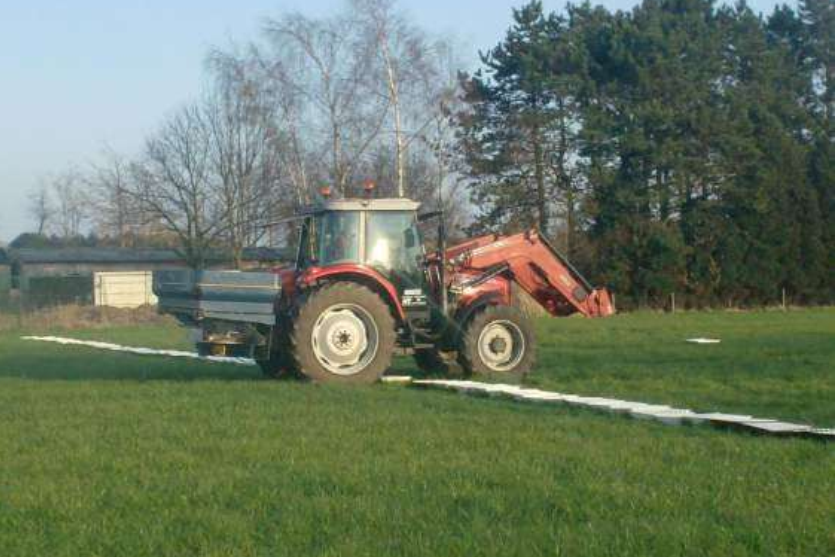
Photo credit: STRATUS
Optimizing fertilizer inputs in agricultural production systems is seen as an important strategy to reduce their large environmental impact while supplying the world’s increasing need for food, fibre and fuel. Centrifugal fertilizer spreaders are by far the most used mineral fertilizer spreaders due to their large working width, small size, low price and their simple and robust design. Although simple in working principle, the spreading process is difficult to control because it depends on various parameters such as the physical properties of the fertilizer particles, wind conditions, spreader settings, etc. Therefore, deviations between the desired and the actual spread pattern can occur in practice, leading to local under- and over-applications and losses out of the field.
To assess the spreader performance at farm level and adjust the machine, if necessary, the spread pattern must be determined. The uniformity of the spread pattern is assessed by measuring the single transverse spread pattern by placing a row of collection trays equipped with anti-reflection grids in the field perpendicular to the driving direction. After collection, material from each tray is weighed and converted into an application rate. Because of their working principle, broadcast fertilizer spreaders generate gauss or trapezoid shaped spread patterns. As a result, the applied dose is higher centrally behind the spreader and decreases towards the sides of the spreading width. Because of this, overlap is necessary between subsequent swaths to achieve a homogeneous distribution.
Spread uniformity across the swath width is calculated (and expressed as coefficient of variation (CV)) and the optimal swath width (and corresponding application rate) can be determined based on the
measured single spread pattern. According to the European standard EN13739 (2003) (1), the CV should not exceed 15%. If an undesirable spread pattern is measured, the next step is to adjust the spreader setup to obtain a more uniform spreading. This can be done, for example, changing the position of the vanes on the disks, height above the ground, position of the orifice, etc. These measurements are mostly performed for mineral fertilizer centrifugal spreaders but are also applicable for pendulum and manure spreaders. Besides the problem of under- and over-application, broadcast fertilizer spreaders have a high risk of spreading beyond the field border because of their large working width and typical spread pattern. To avoid these losses to the environment, different border spreading technologies (e.g. deflector plate, disc-integrated border spreading…) are now available. Using the collection tray method, the performance of these technologies can be tested and optimized further contributing to optimal fertilizer use.
(1) EN 13739:2003 Agricultural machinery – Solid fertilizer broadcasters and full width distributors – Environmental protection