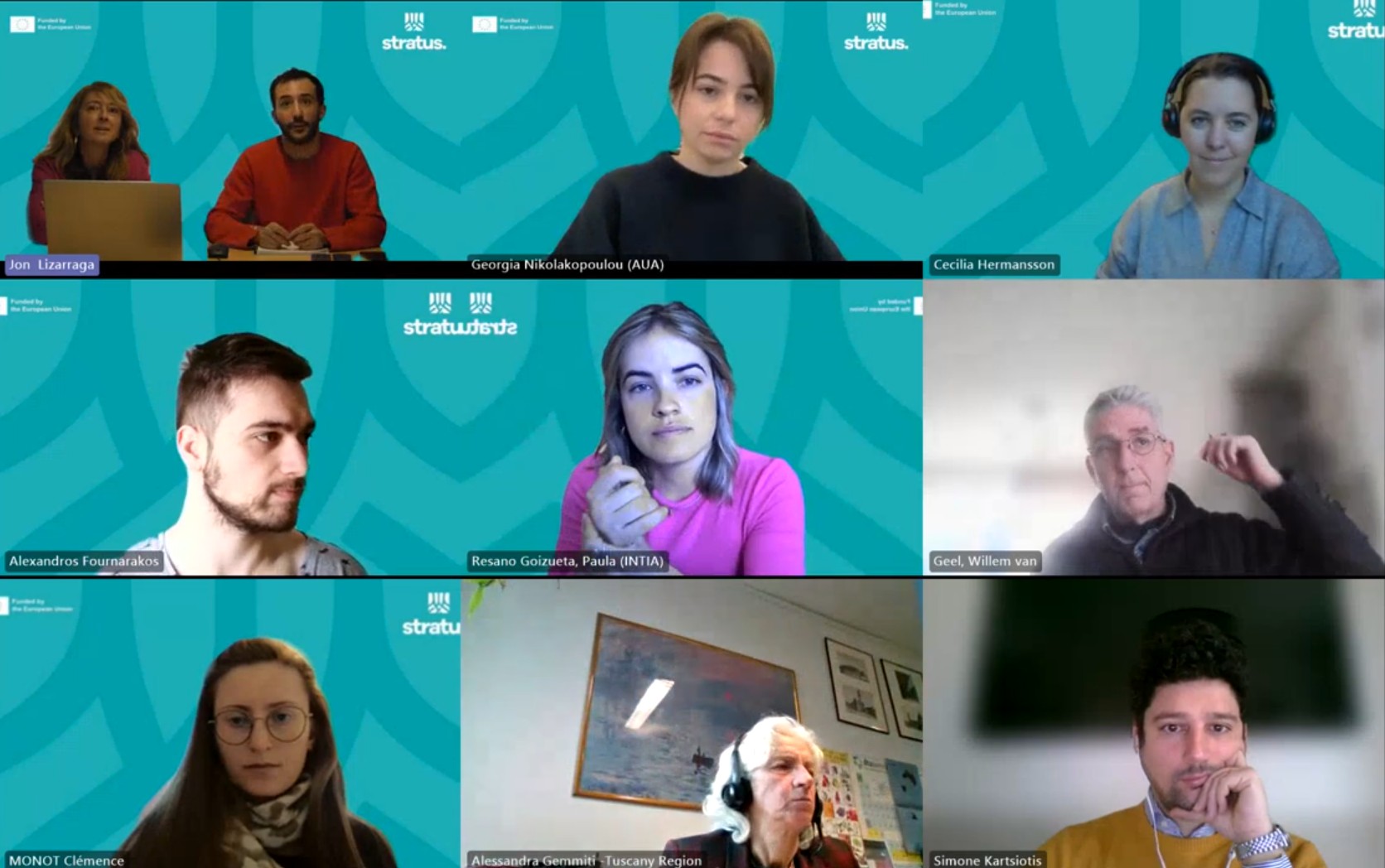
More than 100 people logged in last Wednesday to participate in the first dissemination event of the STRATUS project. STRATUS, the EU project aiming to connect advisors across Europe to accelerate knowledge creation and sharing on Integrated Fertilization Management, started a year ago, in February 2024, at the headquarters of the lead entity, the Institute for Agri-food Technology and Infrastructures of Navarra (INTIA), in Pamplona (Navarra). Since then, the thirteen partner organizations have become proactive and have started to organize communities of practice at the regional level around their three central themes: biobased fertilizers, soil quality and precision agriculture, always under the umbrella of integrated fertilization management. They have also organized themselves to connect at an international level in a network of advisors covering these three themes, and to share the knowledge that is being generated in different parts of Europe and at different levels of development, from already consolidated practices to very incipient innovations that still need to be further developed.
Last Wednesday’s event, of which a recording is available on the STRATUS YouTube channel, offered the opportunity to address these issues and present the project´s first results. The event was organized around three sessions: the first one, dedicated to precision agriculture, featured presentations from four experts: Alessandra Gemmiti, from Tuscany Region government (Italy), presented the activities and commitment of Tuscany Region to support precision agriculture. This was followed by two case studies & live examples of drone technology in agriculture: Simone Kartsiotis presented Agrobit, an innovative startup funded in 2022 and based in Florence that develops solutions for Digital Agriculture, in this case focused on the different options provided by drones; and Alexandros Fournarakos from the Agricultural University of Athens presented the ICAERUS project. ICAERUS is a European project that explores drone-based opportunities to apply, showcase and support the effective, efficient and safe deployment of drones as well as identify the risks and added values associated with their use in agriculture, forestry and rural areas. To conclude the session on precision farming, Georgia Nikolakopoulou, also from the University of Agriculture of Athens, gave a presentation entitled “Precision agriculture, new technologies & drones in farm management and precision fertilization”.
The second session focused on biobased fertilizers. Willem van Geel, from the Field Crops unit of Wageningen Plant research (The Netherlands), presented “From Waste to Wealth: Bio-Based Fertilizers Transforming Farming”, with interesting data and results based on his research in The Netherlands that captured the attention and questions of the audience.
The third session, focused on soil quality, was presented by Cecilia Hermansson (Hushållningssällskapet Sjuhärad, Sweden), who gave an inspiring presentation on biochar, entitled “Sowing Sustainability: Enhancing Soil Quality for Future Farming”, a topic that attracts the interest of many advisors through Europe nowadays as well as several questions from the audience.
After a panel discussion where questions from the audience were answered, Clémence Monot from Vegepolys Valley (France) presented the first results of the project. The project already has 52 good practices, selected collectively between academia, advisors and farmers in the project countries, which bring new ways of managing soil fertilization. These good practices have been collected in a unified format so that they can be translated into 10 country languages and disseminated in all EU countries. They will soon be available on Zenodo. The 52 documents compile: 14 Good Practices for bio-based fertilisers (BBF), dealing with sustainable, affordable and high-quality bio-based alternatives from various residues and waste streams, which can partially or completely replace synthetic mineral fertilisers; 20 Good Practices for precision farming (PF) that focus on the use of technologies and digitalisation to optimise the use of fertilisers; and 18 Good Practices for soil quality (SQ): they focus on various agricultural techniques, including alternative crops, plant cover, carbon farming and optimising the timing of input application for more sustainable nutrient management. These practices aim to reduce nutrient losses while ensuring soil fertility and quality. Clémence presented some of the good practices more in detail, so that the audience could understand how to use these factsheets, with numerous graphs and images, and how useful they can be in their day-to-day work as advisors.
Paula Resano, from INTIA (Spain), was in charge of opening and closing the event, explaining the context and the objectives of the network of advisors that the project creates, and inviting the audience to follow coming results and calls for activities that will be shared through the project website and social media.