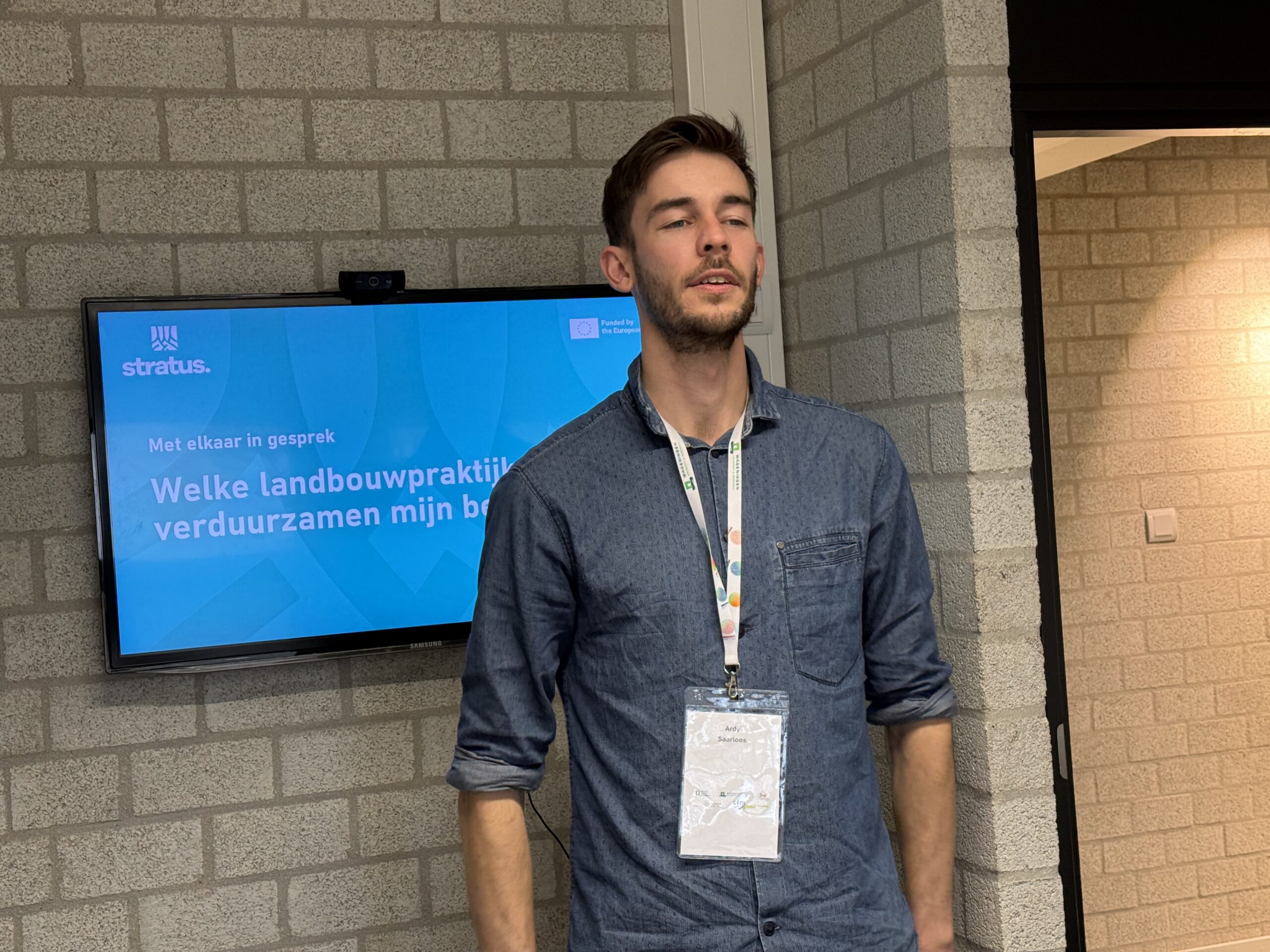
Dialogue on sustainable fertilisation during the STRATUS workshop
On 2 December, STRATUS organised an interactive workshop during the Knowledge Day Sustainable Soil Management in Practice. A healthy soil was central to the day, as it is essential for good yields and future-proof agriculture. The workshop explored which agricultural practices can make fertilisation more sustainable. Researchers, advisors and farmers engaged in dialogue to share knowledge and experiences on how these measures can be implemented in practice.
Discussing challenges
The workshop addressed current challenges in nutrient management, namely circularity (closing nutrient cycles), environmental impact (reducing leaching and emissions), price volatility of inputs (dependence on mineral fertilisers makes farms vulnerable to price spikes), and the maintenance and improvement of soil fertility (productive and resilient soils). Based on these themes, discussions were held using propositions about the role of soil quality in future yields and the combination of precision agriculture and organic fertilisers.
Good agricultural practices as low-hanging fruit
STRATUS emphasises that many issues related to fertilisation and soil quality can already be addressed through good agricultural practices. STRATUS collects a range of good practices from different European countries, with the aim of making them accessible and learning from each other about challenges and solutions.
Working with practical case studies
During the workshop, participants worked in groups on two representative farm case studies for the Dutch context: an arable farm on marine clay soil and a farm on sandy soil, each with associated crop rotation plans. Based on the question which measures contribute to more sustainable soil management in arable farming, now and in the future?, the groups explored various best practices in the following areas:
- Bio-based fertilisers: application of sewage sludge, application of biochar, use of digestate from small-scale digesters, air scrubbers in livestock housing to produce ammonium sulphate, and undersowing with clover
- Precision fertilisation: creation of prescription maps based on satellite imagery, moisture sensors to optimise soil moisture conditions and improve nutrient uptake, and the use of digital twins/BOS for fertilisation advice
- Soil quality: soil aeration pressure exchange systems, controlled traffic farming, soil passports, smart cultivation of cover crops, and conscious use of crop residues
Participants were also invited to propose their own measures. These measures were then categorised by participants according to applicability: applicable now, new, or for the future. This was done through discussion of the measures and the knowledge participants had about them.
Reflection and exchange
The workshop concluded with a review of the choices made by each group, allowing insights to be shared among participants. Thanks to the workshop design and the group discussions, and the active contributions of participants, the workshop can be regarded as inspiring. The insights gained can help further explore and apply sustainable agricultural practices.