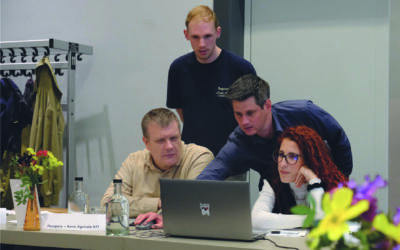
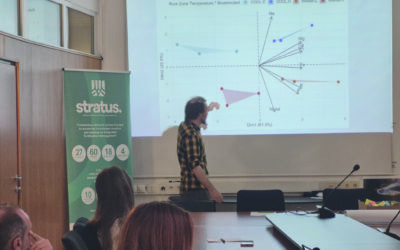
For its annual General Assembly on January 21-23, 2026, the STRATUS consortium met in Ghent, this time with partner EVILVO as the host. The event took place in the 90-meter-high tower of the Flemish Government’s VAC Building, next to Sint-Pieters Train Station. Upon...
General
Dialogue on sustainable fertilisation during the STRATUS workshop
Dialogue on sustainable fertilisation during the STRATUS workshop On 2 December, STRATUS organised an interactive workshop during the Knowledge Day Sustainable Soil Management in Practice. A healthy soil was central to the day, as it is essential for good yields and...
The Role of Biodynamic Viticulture in Soil Quality and Plant Resilience
Introduction Soil quality directly affects vine vigor, grape composition, and the personality of the wine. In conventional vineyards, intensive tillage, chemical fertilizers, and frequent pesticide use tend to degrade the soil, cause erosion, especially in the...
Navigating Smarter Farming: Slovenia’s Role in STRATUS
In the ongoing effort across Europe to achieve more sustainable farming, ensuring our land is both productive and environmentally sound is a shared priority. The STRATUS project is at the forefront of this movement, bringing together agricultural advisors to advance...
Strengthening Collaboration: STRATUS Presented at the I3-4-Biofertilizers General Assembly
The STRATUS project was recently presented at the General Assembly of the I3-4-Biofertilizers project, held in Rouen, France. This event brought together around 40 participants from across Europe, including representatives from SMEs, innovation clusters, regional...
A One-Page Fact Sheet to Select Best Practices
How does one design a fact sheet that fits on one page, on the one hand, and contains sufficient information for a selection process, on the other hand? This was the challenge ILVO and co-WP leader WUR faced as they entered the second phase of WP3. Preceded by a...
STRATUS joins the launch of the AdvisoryAgriHub Platform!
STRATUS is excited to announce the launch of the AdvisoryAgriHub! The AdvisoryAgriHub is a central hub tailored to agriculture and forestry advisors, aiming to provide tools to improve their advisory competencies. The platform was developed through the collaborative...
Let’s Learn Together, Grow Greener: Why Cross-Visits and Demos are Key in STRATUS
When we talk about making farming more sustainable across Europe, sharing what we know is crucial. The old ways of using fertilizers can sometimes cause problems for our environment, affecting our soil, water, and even the air. So, farmers and advisors are always on...
Neutralizing the Problem: Why Liming is Key to Healthier Soils in Poland
Liming is one of the basic agrotechnical measures. Aims to improve soil pH by increasing its pH. Too acidic soil negatively affects the availability of nutrients, limits the development of soil microorganisms and reduces the yield of crops. An optimal soil pH is...
Fertilising the future: empowering trainers with multimedia tools
Today’s farming innovations go beyond equipment and techniques—they also depend on how well knowledge is shared. That’s why having clear information, strong networks, and training materials tailored to farmers and advisors is so important. Often useful insights come...
Influence of Karstic Soils and Microclimate on Soil Quality and Resilience in Organic Olive and Sour Cherry Production in the Makarska Region
The Makarska highlands in southern Croatia are characterized by a specific microclimate and extremely rocky soils, distinguishing agricultural production in this region from other parts of Croatia. These two factors create unique conditions for sustainable and organic...
First Swedish Carbon Credit Standard with Biochar Rewards Farmers and Improves Soil Health
A new carbon credit standard developed through the project Kolsänksrätter med biokol is opening exciting opportunities for Swedish farmers: better soil quality and a new income stream. The first carbon credits under this standard are being verified and issued during...
Good Practice on Soil Quality nº18: Biochar as soil amendment
Biochar is used as a soil amendment due to its properties of storing water and nutrients. It is also a carbon sink and can thereby be sold as a carbon credit, giving the farmer an additional revenue stream. Biochar is applied on or in the soil, can be applied together...
Research Innovation on Soil Quality nº17: Quality fodder – Quality manure – Quality soil
Changing the crop rotation towards more grass (single, multispecies, with legumes) in a fodder producing agricultural system for cattle production will positively benefit soil quality by breaking monoculture (or dominance) silage maize, a crop with very low...
Good Practice on Soil Quality nº16: Preventing and resolving soil compaction
The prevention of soil compaction by reducing the load per cm² of soil and by taking care of the soil’s carrying capacity is very important because the resolving of deep soil compaction (compaction just below the topsoil, 30-50 cm) is difficult. Resolving of deep soil...
Research Innovation on Soil Quality nº15: Possibilities of using biogas digestate plants as fertilizers and soil improvers
Fertilizer trials will be set up on agricultural land OPGs on three crops in crop rotation/rotation: maize, winter wheat, and Italian ryegrass. Before setting up the experiment, soil samples will be taken in the planned areas in order to determine the initial state,...
Good Practice on Soil Quality nº14: Bioashes for advanced agri-food production & soil fertility
The utilization of bioashes in Croatia presents a valuable opportunity for sustainable disposal and agroforestry applications. These alkaline byproducts, derived from forest biomass plants, can effectively address the challenge of acidic soil (pH < 6) by enhancing...
Good Practice on Soil Quality nº13: Crop rotation
Crop rotation is an important factor in maintaining and improving soil health. Continuously growing the same crop over multiple years can lead to an increase in soilborne diseases, as pathogens specific to that crop are given the opportunity to multiply. When a...
Good Practice on Soil Quality nº12: Cover crop mixing grasses and legumes
Between two main crops is sown a mixture of grasses - oats, rye, buckwheat, Moha - and legumes - often forage species, instead of bare soil. The cover crop is destroyed during its vegetative step before the seed formation. DOWNLOAD THE PRACTICE FACTSHEET
Good Practice on Soil Quality nº11: Reducing soil tillage / Simplified cultivation techniques
Simplified cultivation techniques are practices to reduce soil tillage, without use of ploughing. Their use allows to prevent from erosion and to improve soil biological activity, particularly earthworm presence. Simplified cultivation techniques gather deep ploughing...
Research Innovation on Soil Quality nº10: ORTOBIOATTIVO, agroecology for the sustainable production of nutraceutical vegetables
Development and adoption of a new agronomic approach for vegetable cultivation called “Ortobioattivo. This model focuses on the quality of the substrate/soil and the microbiological biodiversity contained therein as a fundamental element for the cultivation of healthy...
Good Practice on Soil Quality nº9: IOCONCIV introduction and optimization of techniques and systems for control of vineyard weed flora
The general objective is to reduce the use of herbicides in Tuscan vineyards (glyphosate in particular) and improve the fertility of vineyard soils. The proposed innovation involves the use of cover crops under the vine rows in order to reduce the use of herbicides or...
Good Practice on Soil Quality nº8: Catch crops
A plant grown between two main crops for green fodder, hay, silage, ploughing as green manure or leaving in the form of mulch after they have been cut, dumped or destroyed by frost. DOWNLOAD THE PRACTICE FACTSHEET
Good Practice on Soil Quality nº7: Soil liming
Due to sandy soils (70%) and climate, Poland has problems with soil acidification. Over 4 million hectares have a pH in KCl below 5.0 - such soils can be considered degraded - they have a damaged structure, plants are not able to absorb nutrients, which leads to water...
Good Practice on Soil Quality nº6: Split n application – for grain crops, dividng the dose into 2 or 3 split applications
This practice is quite common in our region, and it is indeed one of the easiest ways to ensure fertilizer efficiency. Our recommendation is to split N application when the dose is higher than 120 NFU. When using this practice, farmers usually split N fertilizer in...
Good Practice on Soil Quality nº5: Optimal organic matter balance
Calculating an organic matter balance provides insights into the inputs and outputs of organic matter within an agricultural system. Organic matter plays an important role in maintaining soil health, contributing to improved water retention, soil aeration,...
Good Practice on Soil Quality nº4: Manure mediation including digested sewage sludge
Manure mediation represents a strategy whereby farms with an abundance of organic manure can sell this resource to other farms that has a deficit of organic carbon in their system. This approach facilitates the transfer of nutrients from an area with a higher...
Good Practice on Soil Quality nº3: Strip-till in sunflower crop
Strip-till is a minimum tillage practice. This practice combines the advantages of conventional tillage and the soil-protecting benefits of no-till, as the soil is only disturbed on the seed row. In our region, direct seeding is a common practice for grain crops,...
Good Practice on Soil Quality nº2: Soil passport or farm soil and waterplan
Based on all the properties of the soil, you'll be able to advise on measurements to decrease the loss of nitrogen and phosphorus to the environment and how to manage water in the best way possible. DOWNLOAD THE PRACTICE FACTSHEET
Research Innovation on Soil Quality nº1: Cut and carry fertiliser
Instead of 'brown' manure. The pathway over animals gives products but is accompanied by substantial losses of nitrogen. Using the grassclover directly, these losses are avoided. Technically seen there is no problem: no new machinery is needed or other challenges to...
Good Practice on Precision Farming nº20: Localized application of nitrogen and phosphate starter fertilizers when sowing maize
Localized starter fertilizer applications are already applied to 75% of maize acreage in France to enhance nutrient efficiency and minimize environmental impacts. Localized fertiliser application involves applying fertilizer directly to the roots of plants at sowing,...
Research Innovation on Precision Farming nº19: Integrating multispectral drone imaging, IOT sensors, and agronomical models for precision fertilisation in organic open field vegetable production
The practice involves integrating advanced precision farming technologies, including multispectral drone imaging, IoT soil and environmental sensors, and agronomical models, to optimize fertilization in organic open-field broccoli production. Unlike traditional...
Good Practice on Precision Farming nº18: Precision nitrogen management using historical yield maps and variable rate technology in grain crops
The practice of Variable Rate Fertilizer Application (VRFA) based on historical average yield maps allows farmers to optimize fertilizer use by targeting specific zones within their fields. This practice relies on precision machinery equipped with yield monitors and...
Good Practice on Precision Farming nº17: Leveraging drone technology for fertilizer optimization in tomato and corn crops
Fertilizer management using drones is an advanced precision agriculture technique that optimizes nutrient application, enhances yields, and reduces environmental impact. This practice integrates drones equipped with multispectral cameras, specialized software for data...
Good Practice on Precision Farming nº16: NDVI-driven drone-based field analysis for precision nutrient management
Drones equipped with multispectral cameras fly over fields to capture images, which are analyzed using software programs like Pix4Dmapper. This software creates detailed maps that pinpoint areas needing different levels of fertilizers and water. This targeted approach...
Good Practice on Precision Farming nº15: Variable rate fertilizer application based on NDVI maps created with Sativum app in grain crops
SATIVUM is the free digital tool chosen by the Spanish Government as the reference farmer's digital book. It was designated as the reference tool in 2024, and it is being developed to have a wide range of functionalities. It allows farmers to register their plots,...
Good Practice on Precision Farming nº14: Precise fertilizer applications using software tools and satellite NDVI imagery in arable crops
Polish arable farmers widely use computer programs that calculate the nutrient balance (N, P, K) on the field, and prepare fertilization plans in accordance with the principles of sustainable mineral management. Examples of fertiliser advisory applications software...
Good Practice on Precision Farming nº13: Site specific yield determination in potatoes to understand local nutrient needs and surpluses in crop residues
When reviewing the yield quantity for their potato crop, farmers usually calculate the average amount of yield per hectare of a certain field, in some cases even over multiple fields. However, the variation in crop yield within fields can be relatively large. Knowing...
Good Practice on Precision Farming nº12: Realtime measuring nitrogen content when applying animal manure to visualize uneven distribution
When using animal manure, there is often a large variation in the amount of nutrients applied over the field. Manure is transported with trucks and when applying animal manure different trucks come from different locations. Although the manure comes from the same type...
Research Innovation on Precision Farming nº11: Prescription maps for fertilizations in vineyards using 3D point cloud and AI algorithms on mobile device
3D point clouds (big data) generated by the Mobile App iAgro optimize variable-rate fertilizations in vineyards. Acting as a Decision Support System (DSS), the app leverages AI computer vision algorithms, that automatically analyze vineyards digital twin and assess...
Good Practice on Precision Farming nº10: Prescription maps for variable rate fertilisation using crop vigor maps
Site-specific fertilization using vigor maps is a precision farming technique designed to optimize fertilizer use, enhance agricultural yields, and minimize nutrient losses and environmental impacts. These vigor maps are generated from data collected through sensors...
Good Practice on Precision Farming nº9: Site specific estimation of winter cereals and rapeseed nitrogen needs via satellite
The theoretical calculation of crop nitrogen needs in France has been carried out since 1992. This calculation is used to comply with the Nitrates Directive (European directive). The necessary data are provided by technical institutes and aggregated through COMIFER...
Good Practice on Precision Farming nº8: Cropsat – Free satellite imagery for tailored nitrogen fertilization in wheat
CropSat is a free precision farming tool developed in Sweden that leverages satellite imagery to optimize nitrogen fertilization, particularly for crops like wheat and other cereals. The tool uses Normalized Difference Vegetation Index (NDVI) data from satellite...
Good Practice on Precision Farming nº7: Use of the online information platform watchitgrow to generate task maps for variable fertiliser applications
WatchITgrow is an online platform to support farmers in monitoring arable crops and vegetables more efficiently in view of increasing yields, both qualitatively and quantitatively. It is a collaboration platform for everyone in the sector, from growers, contractors...
Good Practice on Precision Farming nº6: Fertiliser spread pattern measurement and spreader adjustment using collection trays
Optimizing fertilizer inputs in agricultural production systems is seen as an important strategy to reduce their large environmental impact while supplying the world’s increasing need for food, fibre and fuel. Centrifugal fertilizer spreaders are by far the most used...
Good Practice on Precision Farming nº5: Developing precise fertilisation plans with regard to WRA using satellite imagery and drones in maize and cereals
Satellite images are particularly suited for crops such as cereals, maize, and other field crops, as their scale aligns with the spatial resolution of Sentinel-2 satellite imagery. These images, combined with drone technology, provide essential data for implementing...
Good Practice on Precision Farming nº4: Use mobile apps and satellite images to identify fertilisation needs
This practice describes the use of available satellite images to monitor actual crop status and act quickly on it. This helps to use fertiliser inputs more efficiently and reduce costs. Variable rate fertiliser prescription maps are traditionally based on soil samples...
Good Practice on Precision Farming nº3: Zero spots method to optimize wheat nitrogen fertilization
The zero spot fertilization method for wheat is based on the following principles: The nitrogen supply to the wheat during the growing season is done in three steps. 1) The first application in early spring at the time of the start of wheat growth (BBCH30 (middle of...
Good Practice on Precision Farming nº2: Advanced nutrient management using soil analysis and growth simulation
To optimise crop growth throughout the season, it is important to offer the right amount of fertiliser to the crop at the right time. In The Netherlands several institutes offer a method that combines soil samples and crop growth modelling to optimize crop...
Good Practice on Precision Farming nº1: Soilexact, the use of soil moisture sensors to optimize irrigation and soil moisture content
Soil moisture sensors can measure soil moisture content. Growers use that information, for example, to prioritize irrigation of fields: which ones should be irrigated first, which can wait? This is especially important in situations where the fields of a farmer are...
Compost: Gardner’s Black Gold
Compost is a powerful natural fertilizer that improves soil structure, boosts plant health, and supports sustainable agriculture. But using too much can backfire. Learn how to apply compost correctly, understand the phases of composting, and discover the benefits of advanced types like vermicompost.
Good Practice on Biobased Fertilisers nº14: Biochar, innovations through carbonizations tested in amiata and maremma
Biochar is a carbon-rich material produced by pyrolysis, which is the thermal decomposition in the absence of oxygen. This usually occurs in organic biomass, such as wood, agricultural residues, or other plant materials. It is primarily used as a soil amendment to...
Good Practice on Biobased Fertilisers nº13: Fertibio development of the production process of biofertilizers
The biofertilizer contains primarily of beneficial microorganisms, including arbuscular mycorrhizal fungi (AMF), bacteria, and other fungi. These microorganisms are produced in vitro, in axenic cultures, and in vivo, resulting in effective inoculants. The AMF included...
Research Innovation on Biobased Fertilisers nº12: The use of biochar in growing media for soilles cultivation in horticulture
Growing media include any materials other than soil used as a horticultural substrate for plant rooting and cultivation in a confined volume, as part of controlled environment agriculture. These growing media are used for growing vegetables, fruits and ornamentals in...
Good Practice on Biobased Fertilisers nº11: Optimizing fertilization by using non-microbial biostimulants
Biostimulants aim to improve the effectiveness of fertilization, the efficiency of plant nutrition. Their use is rather preventive. A plant biostimulant is a product that stimulates plant nutrition processes independently of the nutrients it contains, with the sole...
Good Practice on Biobased Fertilisers nº10: Use of digestate originating from small scale farm digestion
Small-scale anaerobic digestion of residual flows (mainly at dairy farms) can help the farmer to fulfil the electricity needs of the farm and partly the heat demand through combustion of biogas in a combined heat and power unit. It has a local character and limited...
Good Practice on Biobased Fertilisers nº9: Solid fraction of a digestate from plant material
Digestates are the majority by-product of methanization. They are rich in organic and mineral elements, giving them a high organic fertilizer potential. The spreading of digestates, particularly of agricultural origin, is the most commonly carried out practice in...
Good Practice on Biobased Fertilisers nº8: Agricycling, regional usage
This good practice is inspired by a collaboration between farmers with a partnership with governments, and nature organizations called Agricycling. However, the initiative can be applied in many other places. It focuses on reusing available residual streams...
Good Practice on Biobased Fertilisers nº7: Guaranteed level of nutrients manure products
To ensure optimal nutrient use, it is important to guarantee the nutrient levels in animal manure before application. This approach is especially relevant for slurry and other processed forms of biobased fertilizers. By precisely determining the nutrient composition,...
Research innovation on Biobased Fertilisers nº6: Stripping-scrubbing of liquid fraction of pig manure to produce ammonium nitrate
Stripping-scrubbing of the liquid fraction of pig manure allows for on farm production of biobased fertilizer. It starts with the liquid fraction of pig manure followed by scrubbing for ammonium salt recuperation. The operating principle of stripping-scrubbing is that...
Good Practice on Biobased Fertilisers nº5: Scrubbing of stable air to produce ammonium sulphate
Emissions of NH3 from livestock housing and slurry storage represent a large part of the total NH3 emissions from agricultural activities. Therefore chemical air scrubbing is used to reduce the ammonia and odor components in stable air. Water with added sulfuric acid...
Good Practice on Biobased Fertilisers nº4: Managing nutrient availability rate from municipal sludge
Municipal sludge is a large source of nutrients. Unlike other organic fertilizers, municipal sludge has a stable composition, enabling precise adjustments to mineral fertilization. Nitrogen in organic fertilizer is available in different ways, and depending on which...
Good Practice on Biobased Fertilisers nº3: Pig slurry composition analyisis
Since 2022, it is mandatory in Spain to have a recent product analysis when applying organic fertilizers. However, this is not yet a common practice among farmers. Pig slurry, as a widely used organic fertilizer, play an important role in the fertilization strategy of...
Good Practice on Biobased Fertilisers nº2: Cut & carry fertilisers
Cut and carry fertilizers are organic fertilizers produced from plants. Those plants are often leguminous species. The plants are grown in one place and, after being harvested, transported to another location and applied as fertilizers. In between they might be dried...
Good Practice on Biobased Fertilisers nº1: Using and retaining crop residues
Depending on the crop, crop residues can contain considerable amounts of nutrients. The nutrients are for instance stored in leaves, which are after being harvested left on the field. When degrading, those nutrients become available for soil organisms and the...
Strengthening Farm Advisory Services: Soft Skills Workshop Highlights Key Challenges and Solutions
On January 29th, STRATUS, OrganicAdviceNetwork, and AdvisoryNetPEST co-hosted an interactive online workshop focusing on the essential soft skills required for farm advisors. This event brought together agricultural advisors from across Europe to discuss the...
STRATUS Promotes Knowledge Sharing with First Dissemination Event on Integrated Fertilization Management
More than 100 people logged in last Wednesday to participate in the first dissemination event of the STRATUS project. STRATUS, the EU project aiming to connect advisors across Europe to accelerate knowledge creation and sharing on Integrated Fertilization Management,...
First Round of Good Practices and Research Innovations delivered
At the end of January, an important step for the project was taken. VEGEPOLYS VALLEY (French cluster on plant) delivered its first deliverable: the first round of Good Practices & Research Innovations collected throughout the consortium. . During several months at...
Register now: Advancing Fertilization Management: ONLINE DISSEMINATION EVENT
One year after the beginning of the project, STRATUS partners have a lot of news to offer to the public in general, and to a more target audience such as farmers, advisors, researchers, students, agronomists, or policymakers interested in integral fertilizers...
STRATUS – First Annual Consortium Meeting & General Assembly
It has been one year since the launch of STRATUS in Pamplona, Spain, and the partners are meeting again for the project´s first Annual Consortium Meeting and General Assembly. Members from all 14 partner institutions, as well as associate partners met in Athens,...
Developing Sustainable Agriculture Through Global Collaboration
Creating sustainable agricultural systems is a global challenge that demands robust networks of knowledge sharing and innovation. A recent example of such collaboration took place at the Agricultural University of Athens (AUA), a STRATUS partner, during a study visit...
A network of advisors specializing in efficient fertilization
The STRATUS project is based on creating a network of advisors specializing in efficient fertilization. This network consists of various entities specialized in precision agriculture, organic fertilizers, soil quality, and advisory services for farmers and ranchers....
Showcasing the latest advances driving innovation in precision farming
One of the challenges of practicing integrated fertilization management to increase production and input efficiency in agriculture is designing better systems for fertilizer use. This was the focus of the event hosted by STRATUS partner ILVO (Flanders Research...
A Framework for Identifying Economically Feasible and Sustainable Fertilization Practices: The STRATUS D3.1 Protocol
The main goal of the STRATUS network is to identify at least 48 Best Practices in Integrated Fertilization Management (IFM) throughout the European Union. This ambitious goal requires a rigorous selection process to ensure the chosen practices are not only effective...
Bringing the knowledge generated by STRATUS to the Spanish agricultural system
STRATUS project coordinator INTIA hosted their first Community of Practice (CoP) on Integrated Fertilization management. Participants shared their knowledge, experience, and good practices on precision farming, organic fertilizers, and soil quality. This is the first...
The use of technology & digitalisation for optimal fertilizer use
The agricultural sector has seen significant advancements with the integration of technology and digitalisation, particularly in the efficient and optimal use of fertilizers. This article explores various technologies and digital tools that are revolutionizing...
STRATUS presentation at the Manuresource conference
Manuresource is a 2-year international conference on manure management and valorisation organised by the Flemisch Coordination Centre for Manure Processing, Ghent University and Inagro. At Manuresource 2024 celebrated during the 20th and 21st of March 2024, the...
Project launch in Pamplona, Spain
The region of Navarra, in northern Spain, has recently hosted the launch of the STRATUS project, whose main objective is the creation of a technical advisory network on the optimal use of fertilisers. This project, coordinated by the public company INTIA, reunites 18...